

Pipe Inspection Safety Risks? K20 Robot Keeps Workers Out of Hazardous Sewers
For municipal engineering teams and industrial plant maintenance personnel, pipeline maintenance accounts for a large portion of annual budgets. Most teams fall into the trap of prioritizing emergency repairs over routine inspections: emergency breakdown repairs cost a fortune while regular inspection efficiency stays low. The hidden costs stem from slow manual surveys, expensive confined-space crews and cascading losses caused by delayed detection of pipe damage. Traditional confined-space inspection requires complicated preparation and standby staff. Tiny pipe defects accumulate over time and eventually trigger major engineering issues such as pipe leakage, blockages and ground subsidence.
Early Inspection Reduces Long-Term Maintenance Costs
Pipe degradation happens gradually. Cracks, wall corrosion, root intrusion and sediment buildup all start as minor issues. If left undetected, the cost of later repairs, full pipe replacement and excavation work will multiply. Intelligent visual inspection enables targeted repair instead of full pipe replacement, which greatly reduces secondary risks such as emergency excavation, traffic disruption and environmental pollution. The core demand for pipeline asset management is a flexible inspection device compatible with multiple pipe sizes and site conditions.
K20 Modular Robot: Flexible Pipeline Inspection Solution for All Scenarios
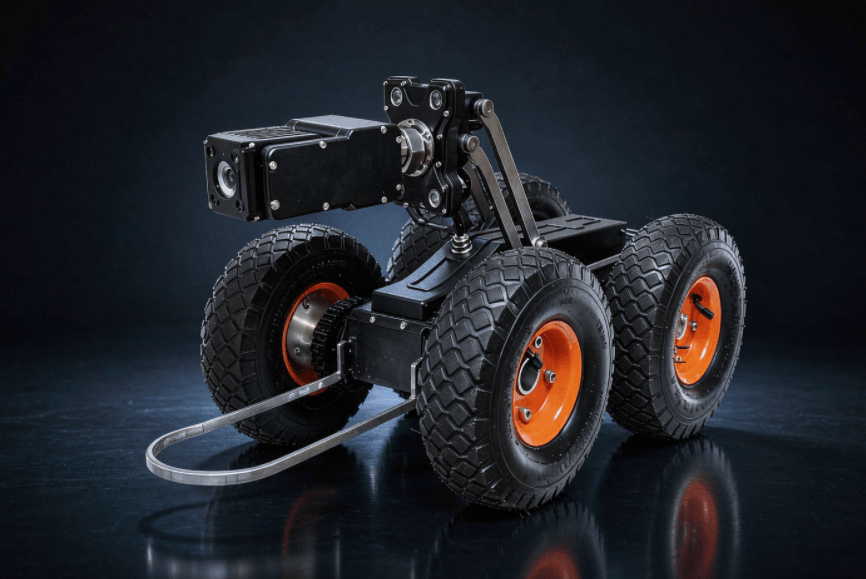
The Muan K20 pipe inspection robot adopts a full modular design, including wheeled crawler host, interchangeable tire sets, automatic cable reel, tablet control terminal and portable power supply. It is easy to disassemble and transport between job sites. Powered by dual-motor six-wheel drive, the robot delivers strong traction and stable movement in muddy, flooded and slippery pipelines. The liftable camera pan-tilt adjusts angles freely to inspect pipe crowns, side walls and bottom sediment without blind spots.
Boasting IP68 waterproof performance, the robot adapts to various damp and flooded pipe conditions. Operators view real-time HD video on a 10.4-inch touch tablet. The standard 100-meter cable supports continuous long-distance pipeline inspection. All captured images and videos can be saved and exported into standardized engineering inspection reports to meet archiving requirements for municipal and industrial projects.
From an ROI perspective, K20 reduces repeated confined-space permit applications and cuts skilled labor hours. The exact payback period can be calculated based on inspection frequency, project volume and local labor costs. Custom quotations are available for projects.
Best Practices for Pipeline Asset Inspection
We recommend a three-level inspection strategy:
- Annual full survey of trunk pipelines: Use K20 to map pipeline health status and record overall pipe defects.
- Targeted re-inspection of high-risk pipe segments: Regularly recheck problematic sections identified in initial scans to track defect development.
- Post-storm inspection: Check for new sediment accumulation, collapse and debris blockages after heavy rain.
This standardized inspection system helps maintenance teams allocate repair budgets rationally, prioritize high-risk hazards, extend the service life of pipeline networks and lower long-term maintenance costs.
FAQ
Q: What is the standard cable length for K20? Is customization available?
A: The standard configuration comes with a 100m cable reel. Custom-length cables are available for long-distance inspection projects.
Q: Is the equipment easy to transport between job sites?
A: Yes. The whole system adopts a split modular design. Components are packed in portable cases for easy transport across municipal and factory sites.
Q: What complex pipe terrain can the crawler handle?
A: It achieves a maximum climbing angle of 60°. Equipped with interchangeable tires, it adapts to smooth concrete pipe walls, muddy pipe bottoms and rough surfaces of aged pipelines.