

Farm Biosecurity
Building a Biosecurity Defense through Automated Cleaning
Automated cleaning reduces the frequency of staff entering pig houses, promptly removes manure and breaks down pathogen biofilms, reducing disease transmission risk from the cleaning stage and protecting farm biosecurity.
Biosecurity Challenges of Traditional Cleaning Methods
Personnel, manure and disinfection — the three weakest links in biosecurity.
Personnel Movement Transmission Risk
Frequent staff entry into pig houses and gutter areas increases the risk of cross-contamination with ASF and other diseases.
Manure Residue Breeds Bacteria
Manure left in gutters becomes a breeding ground for disease bacteria.
Reduced Disinfection Effectiveness
When manure is not fully removed, disinfectants cannot effectively contact surfaces and the biosecurity defense fails.
Building a Biosecurity Defense from the Cleaning Stage
Manure residue in gutters is a major breeding ground for disease bacteria. This solution centers on muanbot-x6 automated cleaning, using remote control to reduce the frequency of staff entering pig houses, promptly and efficiently removing manure and breaking down pathogen biofilms, embedding biosecurity control into every step of the cleaning operation.
Four Core Defense Lines
From personnel, manure, pathogens to environment, guarding biosecurity on all fronts.
Reduce Personnel Entry into Pig Houses
Cleaning is fully remotely controlled with no need for personnel to enter the gutter area, cutting the cross-contamination chain at the operational level.
Prompt and Efficient Manure Removal
High-pressure water jets with a lifting scraper promptly clean gutter manure, preventing buildup that breeds pathogens.
Break Down Pathogen Biofilms
High-speed water flow effectively disrupts bacterial biofilms, significantly reducing manure residue and creating favorable conditions for disinfection.
High-Frequency Cleaning at Key Nodes
Frequent rinsing of key nodes such as pig transfer lanes, disinfection rooms and loading docks builds a complete biosecurity loop.
Four Steps to Implement the Biosecurity Solution
From on-site assessment to routine operation, a professional team accompanies you all the way.
On-Site Assessment
A professional team surveys the trench structure, stall layout and current biosecurity status, identifying risk nodes.
Solution Design
Based on the farm's biosecurity level, customize cleaning frequency, operation routes and equipment configuration.
Equipment Deployment
Complete equipment deployment, water connection and operation training, establishing a standardized cleaning workflow.
Routine Operation
Carry out scheduled cleaning with archived recordings for traceability and periodic follow-ups to optimize the plan.
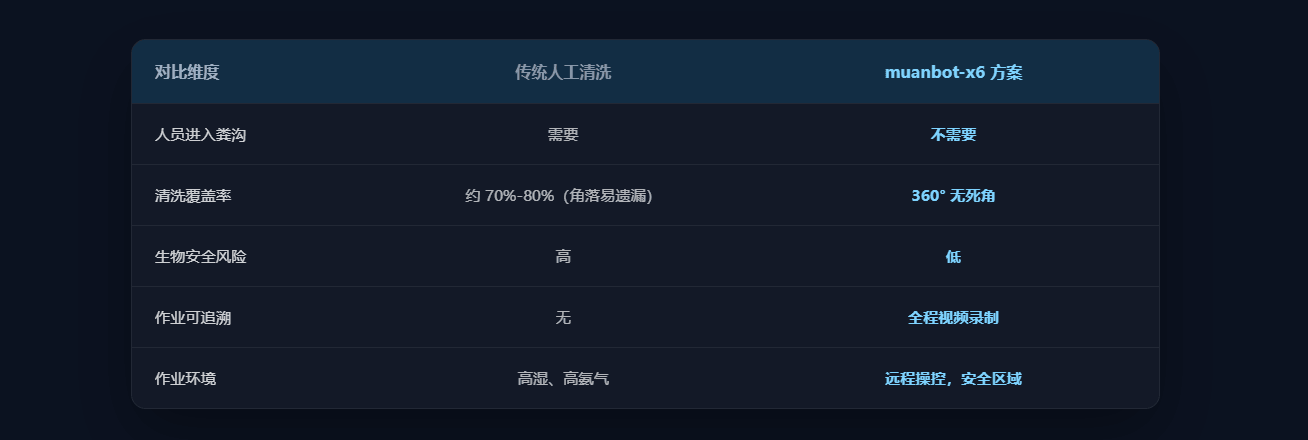
Solution Advantages Comparison
Intelligent robot cleaning vs. traditional manual cleaning — safety, efficiency and cleanliness at a glance.
Protect Your Farm's Biosecurity
Get biosecurity solution materials and on-site assessment services. Our team is always ready to help.